

The Mountain Journal
editorial@themountainjournal.co.ke
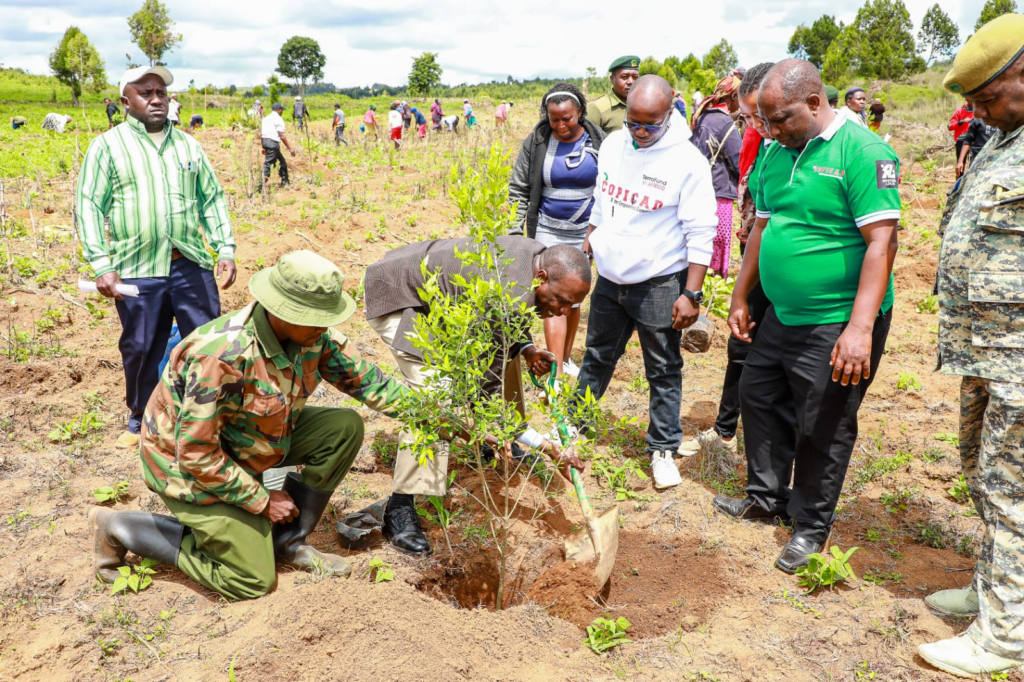
A grassroots organisation is working to restore and maintain 2,500 hectares of land along Lake Ol’Bolossat and the Ewaso Nyiro River in Nyandarua County over the next four years.
As part of this effort, Community Organisation for Positive Impact, Care, and Development (COPICAD) is focusing on the restoration of 2,500 hectares of degraded ecosystems across the slopes of the Aberdare landscape by 2030, while also ensuring verified survival and long-term maintenance of restored areas.
According to COPICAD’s CEO, Thomas Ndiritu, the project aims to address the livelihood challenges faced by smallholder farmers by integrating trees into farming systems. He explained that the initiative is designed not only to restore the environment but also to strengthen household resilience and improve sustainable livelihoods within the community.
In his report, Mr Ndiritu noted that forests across Kenya and Africa continue to disappear, rivers are drying up, and farming is becoming more difficult each year
He emphasised that for many rural families, these environmental changes are not distant or abstract concerns, but issues directly tied to food security, income, and survival.
“Most climate solutions never reach the ground,” he said, adding that many remain confined to reports, policies, or short-term projects rather than creating lasting impact within communities.
“Diversifying income sources, and embedding climate-smart practices. Agroforestry is not treated as a standalone activity but as the structural link between landscape health and household food security,” he said.
The community group has listed key intervention programmes that include training and equipping 15,000 households in the agroforestry system design, maintenance, and product management over five years.
The households, Ndiritu said, will establish community-run agroforestry demonstration plots in each sub-county as learning and seed exchange hubs.
He said a lot has been achieved through the collaboration of the key stakeholders, among them, the Kenya Forest Service, Nyandarua County Government and the national government.
“The agroforestry producers will be linked with the market systems (timber, fruit, fodder, medicinal species) through structured aggregation and buyer relationships,” said Ndiritu.
Johnson Kuguru, an environmentalist in the Mt Kenya region, appreciates the efforts made by the organisation over the conservation of Lake Olbossat, which has helped farmers in parts of Rumuruti and Samburu to embark on cultivation.
“ The organisation rehabilitated the Lake through restoration of the water catchment, which was under the threat of timber merchants and charcoal burners,” said Kuguru.