Portus Chege/The Mountain Journal
editor@themountainjournal.co.ke
The recent death at the hands of Kenyan police of a teacher-cum-blogger painfully recalls the assassination in 2009 of an outspoken human rights activist and brings into sharp focus the spectre of police extrajudicial killing in Kenya.
Albert Omondi Ojwang’, a teacher and social media influencer, was tortured before being murdered by police officers acting at the behest of what is suspected to be one of their seniors. Investigations are currently underway to establish the circumstances under which he was killed and the identity of those who carried out the heinous crime.
A unanimous joint autopsy report by the government and family pathologists returned the chilling verdict: Albert was strangled.
In 2009, lawyer and human rights activist Oscar King’ara was assassinated in Nairobi for his efforts in investigating and documenting extrajudicial killings by Kenyan police. It’s believed that Oscar fell victim to the selfsame menace that he indefatigably and gallantly fought to expose.

Photo/ The late Oscar King’ara who was murdered in 2009 in Nairobi
a murder that has shaken the nation to its very core, Albert’s is a chilling reminder that extrajudicial killing is on the upsurge in Kenya and threatens the fabric of the nation as we know it.
Albert’s murder brings the government squarely into sharp view. No less a person than the second in command in Kenya’s internal security structure is suspected to have called the shots (pun fully intended) in the blogger’s murder.
Deputy Inspector General (DIG) of police Eliud Lagat, who had lodged a complaint over what was regarded as defamatory content earlier posted on social media platform X (formerly Twitter) by Albert, is under intense pressure to step aside for there to be meaningful investigations. Meanwhile, the top cop remains put in office.
As part of the on going investigation Investigative Police Oversight Authority (IPOA) on Friday arrested Central Police Station Officer Commanding Station Samson Talam in Eldoret 263 kilometres from Nairobi.
Two others Policeman, PC James Mukhwan, plus a technician accused of disabling the station’s CCTV, have also been arrested.
Ojwang’s death sparked protests after doctors refuted a police claim he had died from self-inflicted injuries caused by hitting his head on a cell wall. Instead they concluded that it was likely the result of an assault.
Thus far, top police reaction to the shocking murder has been far from persuasive. In fact, it would have been laughable were it not tragic.
The Kenyan public, legislators, civil society organizations and foreign missions all have urged the DIG to step aside, pending transparent investigations by the Independent Policing Oversight Authority (IPOA).
Notably, the United States and UK have called for transparent investigations as Kenyans pour into the streets of the capital to protest Albert’s murder and suspect Lagat’s continued stay in office, which they argue could compromise the investigations.
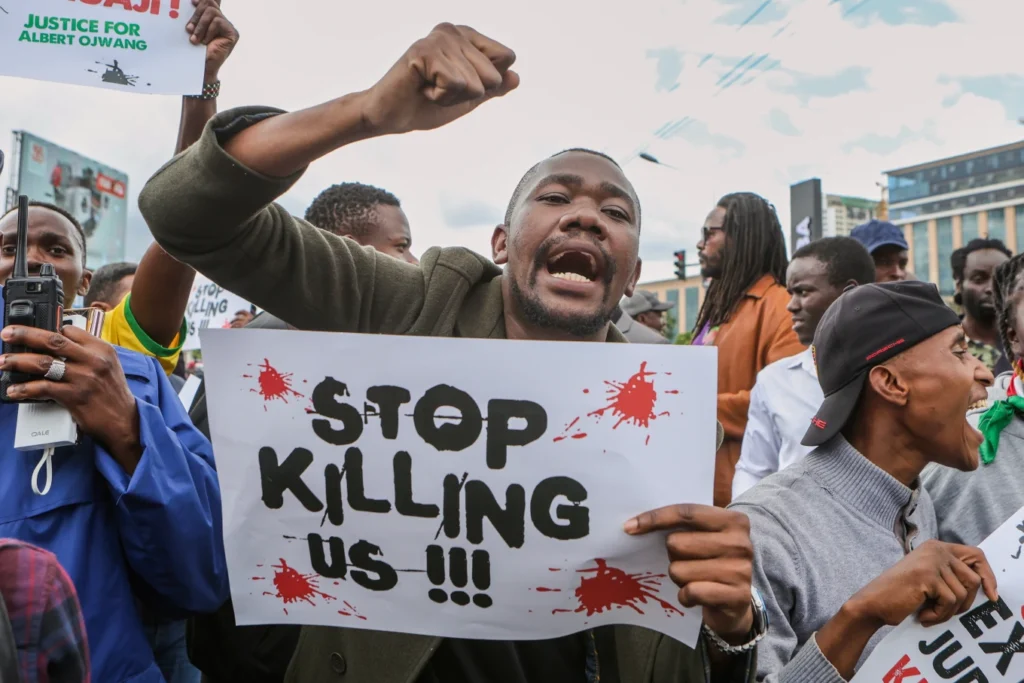
Photo/ Demonstration in Nairobi against death of High School teacher Albert Ojwang killed at Central Police Station
Of deeper significance is that the rising cases of extrajudicial killing in Kenya amount to gross violation of human rights of citizens. It also amounts to breaches of international human rights treaties Kenya has ratified, especially the Convention Against Torture and Enforced Disappearances.
Enforced disappearances and excessive use of force, including lethal force, have long been documented in the country.
Missing Voices, a human rights Non-Governmental Organization (NGO) that seeks to end enforced disappearances and extrajudicial executions in Kenya), in a May 2025 Report, documented a total of 159 cases of extrajudicial killings and enforced disappearance in 2024. Out of that, 104 (65 pc) were incidents of police-related killings, while 55 (35 pc) were those of enforced disappearances. Most of the victims were youth aged between 18 and 34.
According to “‘The Cry of Blood’: Report on Extrajudicial Killings and Disappearances,” a 2008 Report by the Kenya National Commission on Human Rights (KNCHR), a statutory body whose brief is the promotion and protection of human rights; and investigation and documentation of human rights violations, there was need for a thorough inquiry into the role of police officers implicated in violations and prosecution of perpetrators.
Instructively, Oscar handily contributed to the Report, which accused the Kenyan police of killing or torturing more than 8000 people as part of a crackdown on the Mungiki criminal organization.
Oscar subsequently met his death in what clearly was the ultimate price for his human rights work.
Then Government spokesperson Dr. Alfred Mutua (now-CS for Labor) had earlier warned Oscar to go slow on his activities or else…
Extra judicial terror
“His death is an unmistakable consequence of the warning,” Portus Chege, veteran journalist and blogger, reminisces. “Your guess then is as good as mine who killed Oscar.”
Chege a long-time friend who who met Oscar at Nairobi’s China Centre just before the latter succumbed to a hail of bullets while in a traffic gridlock on State House Road.
” Cheated death by a whisker if I was with Oscar,” said Chege our writer,
“Why are they silencing dissent?” Chege wonders. “Whatever happened to (Kenya’s third president Mwai) Kibaki’s freedom of speech?” This is extrajudicial terror.”
No less a personage than UN Special Rapporteur on Human Rights Prof. Philip Alston while on a visit to Kenya, urged the Kibaki government to expedite independent and transparent investigations into Oscar’s grisly murder. As they say, the rest is history.
Freedom from torture and cruel, inhuman or degrading treatment or punishment is a non-derogable right enshrined in the Constitution of Kenya, 2010. The Constitution also guarantees the right to peaceful assembly, expression and demonstration.
On July 2024, hundreds of Kenyan youthful protestors are said to have been killed by police, several injured, others abducted and tortured and others are still missing and feared dead.
The nationwide Gen-Z protests were against the escalating cost of living and a punitive law, the Finance Bill 2024, which sought to introduce punitive tax measures. The protests nearly brought down President Wiliam Ruto’s government, and the president had to withdraw the proposed law. For good measure, President Ruto sacked the whole of his Cabinet, only to reconstitute it with the same old faces, including the current clueless Kipchumba Murkomen, Interior Cabinet Secretary.
The US government, through then ambassador Meg Whitman, sharply criticized the Ruto government and demanded accountability over extrajudicial killings, human rights violations, abductions and enforced disappearances of innocent protestors. Meanwhile, the government kept a studious silence, while protesting its innocence.
King Belshazzar
Just like God was furious with Biblical king Belshazzar for desecrating the Holy vessels, and passed judgment and found him wanting, ‘Mene, Mene, Tekemist, Na Peresi’, so seems to be President Ruto’s fate.
While Ojwang’s murder remains unresolved, the jury is still on the Kenya Kwanza government.