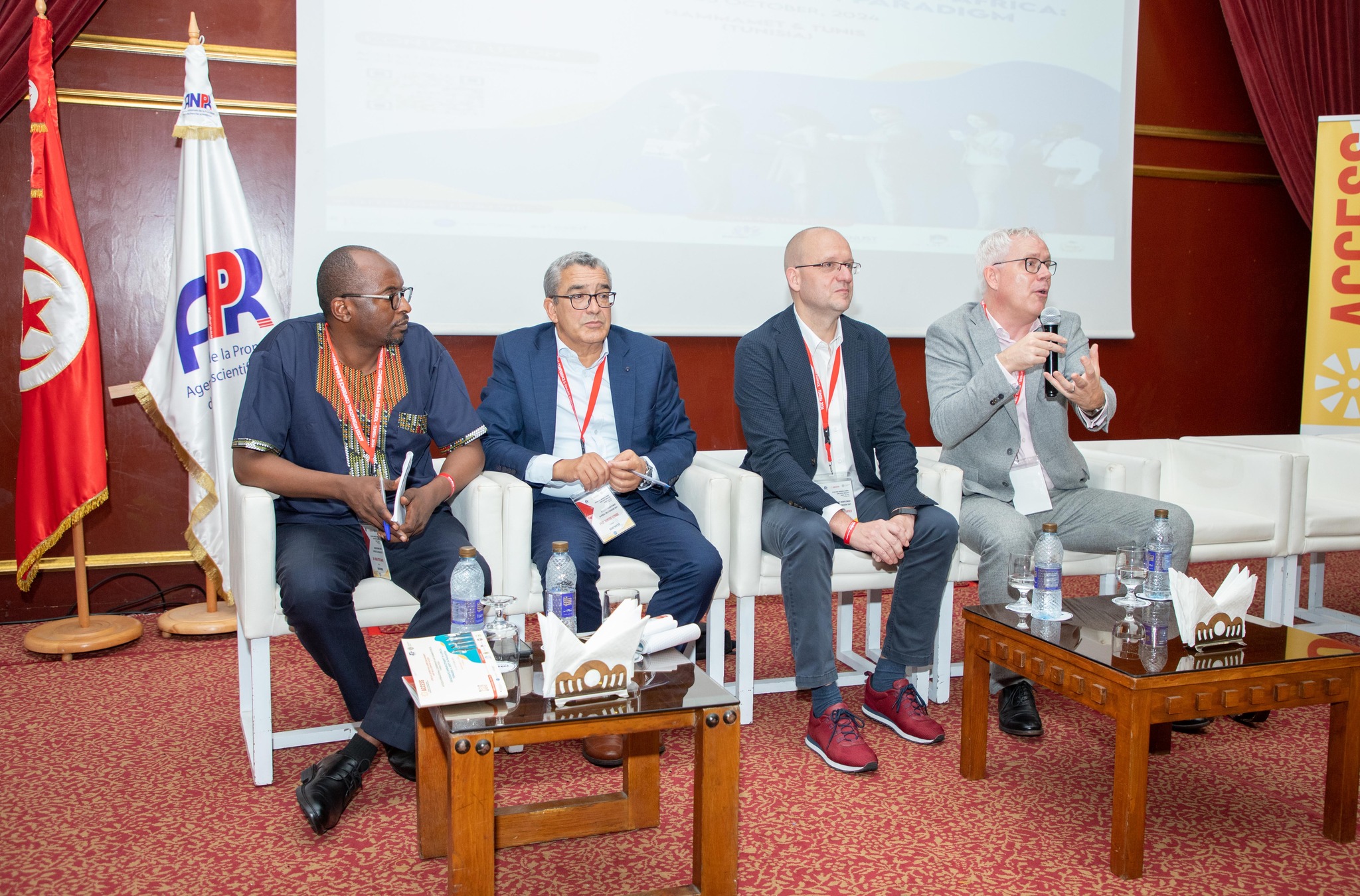
By James Wakahiu
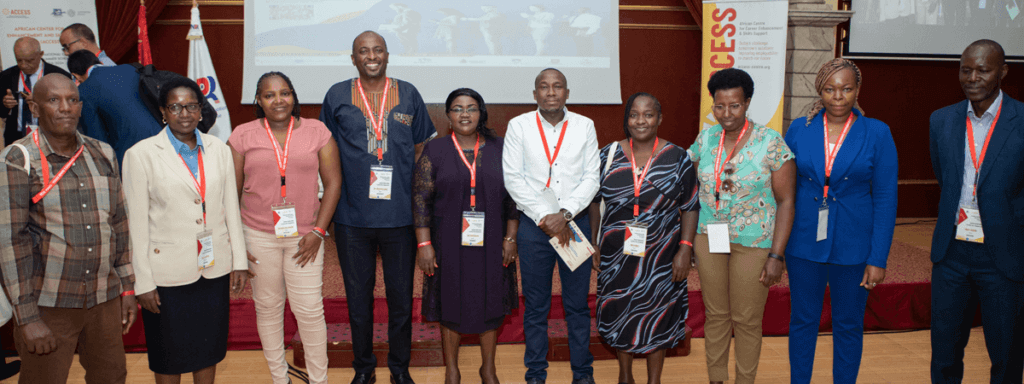
A delegation of nine faculty members from various schools at Mount
Kenya University (MKU) last week attended an international conference
on unemployment of graduates in Africa held in Tunisia.
Led by Access Board Member and Deputy Vice-Chancellor APIA, Dr.
Peter G. Kirira and MKU-Access Coordinator, Dr. Henry Yatich, the
Kenyan team participated and made several presentations at the
Conference and Summer school in University of Tunis at Hammarmet,
Tunisia.
Access 1.0 is a 3.7M Euro German Academic Exchange Service
(DAAD) promoted project under the Exceed initiative with funding from
Germany’s Federal Ministry for Economic Cooperation and
Development (BMZ). MKU is a partner in the African Centre for Career
Enhancement and Skills Support (Access) project which is funded by
DAAD through University of Leipzig, Germany.
The Kenyan faculty successfully disseminated their research findings in
the conference that was running from 1st to 5th October 2024 under the
theme “Graduate unemployment in Africa: Towards a shift in paradigm.
The conference was officially opened by Prof. Dr. Utz Dornberger,
Project Lead, at University of Leipzig Germany.
During the opening ceremony, Prof. Utz announced that DAAD had
approved the award for the roll-out of Access 2.0 project that will be
funded to a total cost of 4.5 million Euros (Kshs 637 million). The new
5-year project will run from 2025-2029 and will focus on more student-
geared interventions to improve graduate employability and industry
linkages.
MKU is the project lead in Kenya and has been submitting tailor-made
measures to curb unemployment in Africa. The institution also organizes
joint annual business idea competitions to be jointly run by 10 local
universities: Zetech University, Karatina University, Strathmore
University, Kenyatta University, Daystar University, Technical
University of Kenya, Kabarak University, Riara University, KCA
University, and Machakos University.
This is the second summer School to be held this year, with the first one
was held in Rwanda in January 2024. Overall, this is the 5th Summer
School. The current project is implemented by a consortium of 7
universities (6 African Universities from Benin, Ghana, Kenya, Nigeria,
Rwanda, Tunisia and coordinated by Leipzig University-Germany.
The researchers from MKU included Dr. Emily Nyabisi, Dr. Josephine
Kirimi, Dr. Jane Kanjuru, Ms. Rose Macharia, Mr. Tobias Ochieng, Ms.
Elena Mwai, Mr. Joseph Machira, Mr. Peter Mbogo, Ms. Judy Nguru,
Dr. Nancy Cheseto and Mr. Jared Mosoti presented topical findings
physically and online on the following topics.
The conference, which brought the Access research program (2020-
2024) to a successful closure, focused on the need to revisit economic
and other theoretical foundations, in order to update the link between
improving the levels of education, particularly university education, of a
country’s human resources, and economic growth and development, in
African countries.
It also analyzed the problems associated with university training in
African Higher Education Institutions (HEIs), the inadequacy of course
selection, and the quality of higher education, all of which contribute to
massive graduate unemployment. The conference also considered how
to redefine and contextualize the concept of employability in Africa.
This major event took place in a regional economic context marked by
rising unemployment on the African continent. According to Prof. Dr.
Hamadi Tizaoui, geographer and economist at the “Faculté des Sciences
Humaines et Sociales de Tunis” (University of Tunis) and organizer of
the event, graduate unemployment, which affects a growing proportion
of the population in many African countries, has become a major
problem.
“Exacerbated by the devaluation of diplomas in a context of limited job
opportunities, this phenomenon is particularly severe for women
graduates. This paradox is reflected in a higher unemployment rate
among graduates than among non-graduates, sometimes reaching levels
four times higher,” he said.
In Tunisia, by the end of 2019, higher education graduates accounted for
41 per cent of the unemployed, with an unemployment rate of 38.1 per
cent for women and 15.7 per cent for men. Graduate unemployment is
particularly acute in disadvantaged interior regions, where it exceeds 50
percent in some governorates such as Kébili and Gafsa. These regional
disparities exacerbate socio-political tensions, triggering social
movements such as those seen in Tunisia in 2011.
“This problem has become a central issue in several African countries,
such as Morocco, Algeria and Senegal. It requires in-depth analysis by
social scientists to understand the underlying economic and political
dynamics,” Prof Tizaoui said.
During the forum, Tunisian business and political leaders shared their
perspectives on cooperation between the university of Tunis and its
economic, social, cultural and technological environment. Academic
networking is encouraged by the Tunisian Ministry of Higher Education
and Research and the university.
These events are part of the programmes implemented by ACCESS, a
consortium of six African universities from Benin, Ghana, Kenya,
Nigeria, Rwanda and Tunisia, working with the University of Leipzig,
Germany, to study the stagnation of the labor market in Africa despite
the increasing level of formal education of the employed and salaried
population.
As a first step, the program set up to investigate graduate unemployment
in these countries. This doctoral program enabled 15 African students,
including three Tunisians, to write or prepare theses in Germany and in
English, on the issues addressed by the program.
The aim was to develop specific, in-depth knowledge of graduate
unemployment and the localized prospects for employability in their
respective countries. Access is also developing new teaching models to
enhance the employability of African students, while increasing their
opportunities in the global market, by connecting them to international
companies.
The consortium aims to create a practical platform for African higher
education institutions (HEIs). It focused on capacity-building for
teachers and doctoral students, integrating teaching and research
practices adapted to socio-economic realities. Academic networking and
cooperation between universities, HEI(s) and companies will also be
encouraged.