
By James Wakahiu
editor@themountainjournal.co.ke
Kenya has reinforced its position as one of the world’s leading floriculture exporters as industry leaders, government officials, regulators and international trade partners gathered in Nairobi for the opening of the 13th International Flower Trade Exhibition (IFTEX 2026).
The African continent’s largest flower industry trade show, held under the theme “Shaping the Future of Floriculture,” brought together a record 210 exhibitors and hundreds of buyers from across Europe, the Middle East, Asia, Africa and the Americas.
For exhibition organiser HPP International, the record turnout at IFTEX demonstrates continued confidence in Kenya’s flower industry despite global headwinds.
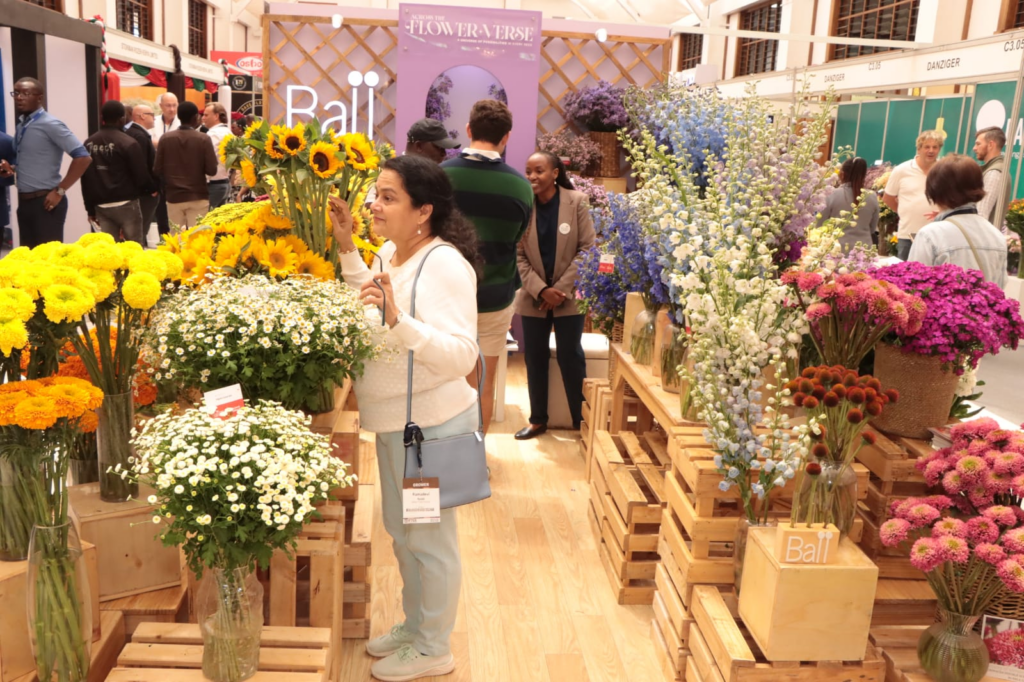
Photo/Guests and exhibitors admire flowers at ongoing Iftex 2026 show at Visa Oswal Centre, Westlands, Nairobi. The three day expo closes on Thursday June 4th.
Mr Dick van Raamsdonk, the CEO OF HPP, said the exhibition had reached a new milestone, attracting the largest number of exhibitors in its history. “This year, we broke every previous record with 210 exhibitors under one roof. Whether you have travelled from across the oceans or across the continent, you are standing at the absolute centre of the floral world,” he said.
Van Raamsdonk said Kenyan growers were responding to changing market dynamics through sustainable farming practices, carbon-conscious operations and market diversification. “The Kenyan flower industry is actively innovating. Our growers are adopting smarter logistics, sustainable farming practices and carbon-conscious operations. We are not just meeting global standards; we are defining them,’’ he added.
Opening the exhibition, Cabinet Secretary for Investments, Trade and Industry Mr Lee Kinyanjui described floriculture as one of Kenya’s most significant economic achievements.
“When many people think about flowers, they think about beauty, colour and celebration. Yet for us as Kenyans, flowers represent something much deeper. They represent jobs and livelihoods, enterprise and innovation, foreign exchange earnings, community development, women empowerment and economic opportunity,” said Kinyanjui.
The CS said that despite rising freight costs, regulatory pressures and global economic uncertainty, the government remains committed to improving the business environment through better logistics infrastructure, faster VAT refunds and expanded market access opportunities. “Our objective is simple: to ensure that Kenya remains one of the most competitive destinations for floriculture investment and trade,” he said.

Photo/Chief guests led by Investments, Trade and Industry CS Lee Kinyanjui ( centre) and Trade PS Regina Ombam (second right) listen to Elgon Kenya MD, Dr Bimal Kantaria (left) at the ongoing Iftex 2026 show at Visa Oswal Centre in Westlands, Nairobi. The three day expo closes on Thursday June 4th.
Currently, the CS said, industry generates more than Sh110 billion annually in export earnings, employs more than 200,000 people directly and supports millions of livelihoods across the country.
Representing the European Union, Filippo Amato highlighted the growing trade relationship between Kenya and Europe, which remains the largest market for Kenyan flowers. “Kenya’s floriculture industry is an excellent example of this partnership in action. Kenya is the world’s third-largest exporter of cut flowers and supplies more than 40 percent of the flowers imported into the European Union,” said Amato.
He noted that Kenyan flower exports to the EU are valued at more than €500 million (Sh75.3 billion) annually and said the bloc would continue supporting the industry through the Kenya-EU Economic Partnership Agreement, export competitiveness programmes and investments in logistics infrastructure, including cold-chain facilities.
Africa’s top exporter
The exhibition comes at a pivotal moment for Kenya’s floriculture industry, which has evolved into one of the country’s most important economic sectors. Today, Kenya is Africa’s largest flower exporter, the world’s leading exporter of rose cut flowers to the European Union, and the third-largest exporter of cut flowers globally. The sector generates approximately Sh110 billion in annual export earnings, supports more than 200,000 direct jobs and sustains millions of livelihoods, particularly among women and young people.
However, like many other sectors of the economy, the sector has been hit by rising oil prices, pending Value Added Tax (VAT) returns, and wildcat demonstrations which often hit parts of the country, leading to road closures and transport hitches.
Kenya’s flowers are blooming, from Nanyuki and Isiolo regions to Kajiado county in the south, from Mount Elgon, Rift Valley and Central Kenya to parts of Ukambani. ‘‘Flowers represent one of the most remarkable economic success stories that Kenya has written over the last four decades. From modest beginnings in the 1980s, Kenya has built one of the most sophisticated and globally respected floriculture industries anywhere in the world,’’ CS Kinyanjui observed.
The blooms have become a global success story, reaching major markets across Europe, the United Kingdom, the Middle East and Asia within hours of harvesting – sometimes within 24 hours from farm to market. The industry has also emerged as a model for sustainable production, investing heavily in renewable energy, water conservation, traceability systems and internationally recognised environmental standards.
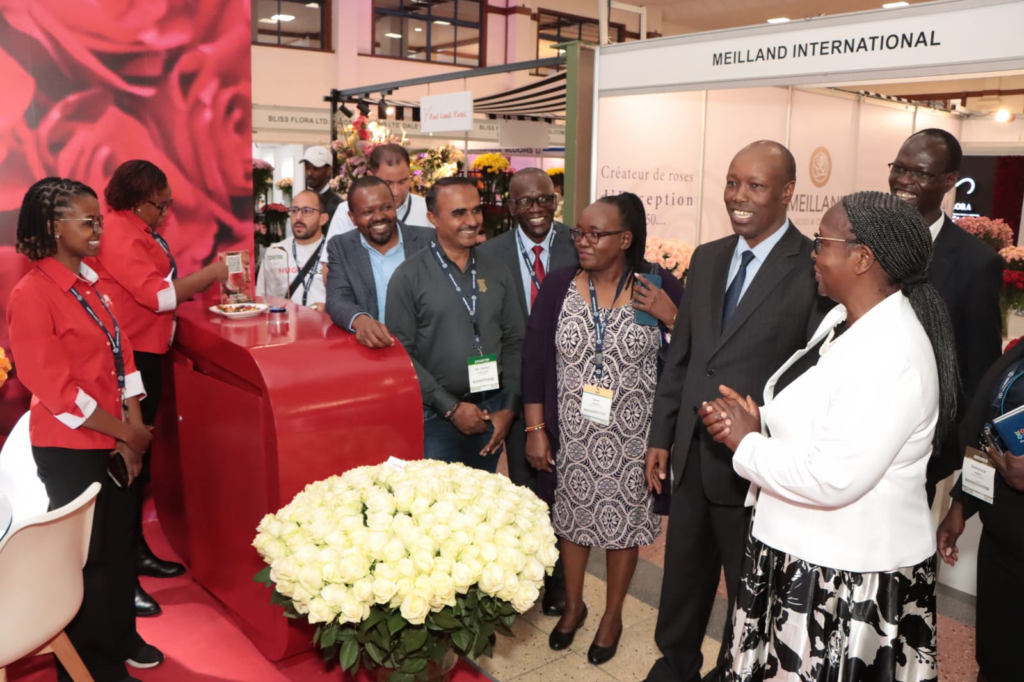
Photo/Chief guests led by Investments, Trade and Industry CS Lee Kinyanjui (second right) and Trade PS Regina Ombam ( right) tour one of award winning stalls at the ongoing Iftex 2026 show at Visa Oswal Centre in Westlands, Nairobi. The three day expo closes on Thursday June 4th.
Kenya Flower Council CEO Clement Tulezi emphasized the broader social and economic impact of the industry, describing floriculture as one of Kenya’s most transformative sectors. “Flowers are jobs. Flowers are school fees. Flowers are healthcare. Flowers are empowerment,” said Tulezi.
While acknowledging the industry’s resilience, he called for greater collaboration across the global supply chain as growers face increasing production, freight and compliance costs. “If the industry is to remain viable, there must be a shared recognition that value must be fairly distributed along the supply chain,” he said, urging international buyers and retailers to engage in transparent discussions on sustainable pricing.
Industry stakeholders also highlighted the role of regulation and plant health in safeguarding Kenya’s export competitiveness. The Kenya Plant Health Inspectorate Service (KEPHIS) Managing Director Prof Theophilus Mutui reported continued progress in strengthening compliance systems and digitising certification processes.
‘‘The False Coddling Moth (FCM) has been a major concern in the exports of roses to our major destination. However, KEPHIS and the industry has continued to work together to address this challenge. We have established a mechanism for management of the pest which I will say has borne some fruit with reduction of the overall interception due to FCM in the last one year. However, more needs to be done as this is a quarantine pest in the EU. We have established a traceability system for the roses we export and are committed to compliance to market requirements. Other challenges are Fall army worm, Whiteflies, thrips and leafminer,’’ he added.
As global demand for sustainably produced flowers continues to grow, industry leaders said Kenya is well positioned to capture new opportunities in North America, the Middle East, Eastern Europe and Southeast Asia while maintaining its dominance in traditional markets.
Over the next three days, IFTEX 2026 is expected to facilitate new business partnerships, showcase emerging flower varieties and technologies, and drive conversations around sustainability, logistics, innovation and the future of global floriculture.
https://shorturl.fm/LK7bD