
Photo/MKU Christian community leaders examine some of the music equipment, laptops and sound systems donated by MKU founder and Board chairman, Prof Simon Gicharu, to various Christian congregations within the university during MKU’s Thanksgiving celebrations held on Sunday February 22nd at Mwai Kibaki Convention Centre in the campus in Thika town. MKU . Photo: Courtesy
By James Wakahiu
Kenyan universities have been warned to fast track their preparedness for the 2029 entry of the Competency-Based Education (CBE)cohort to universities.
The anticipated transition of the Competency-Based Curriculum (CBC) cohort under CBE system into universities in 2029 presents both a challenge and an opportunity for higher education institutions in Kenya. CBE is a 2-6-3-3-3 education system introduced in 2017 to replace the 8-4-4 system.
Now at Grade 10 level, it emphasizes learner-centered, practical skills and talent development over rote memorization. The system is structured into pre-primary, primary, junior school (Grades 7-9), and senior school (Grades 10-12), aiming to prepare students for real-life, 21st-century opportunities.
“These learners will arrive with different educational experiences, expectations and skill sets shaped by a curriculum that emphasizes competencies, creativity, problem-solving, and practical application of knowledge. Universities must begin preparing now,” says National Association of Private Universities in Kenya (NAPUK), Secretary General, Dr. Vincent G. Gaitho.
“The 2029 cohort represents a generational shift that could redefine university education in Kenya. Institutions that proactively embrace this transition will not only remain relevant but will position themselves as leaders shaping the future of higher education. Those that delay adaptation risk misalignment with the very learners they are meant to serve,” he warned.
He said traditional teaching models that rely heavily on passive learning and examination-driven assessment may not fully align with the learner profile emerging from the CBC system. “Curriculum redesign, pedagogical innovation and investment in experiential learning environments will be essential to ensure a smooth transition,” Dr Gaitho, also Pro-Chancellor and Chairman of the Mount Kenya University Council, said.

Photo/MKU founder and board chairman, Prof Simon Gicharu (second right), presents music equipment, laptops and sound systems to various Christian groups within the university during MKU’s Thanksgiving celebrations held on Sunday February 22 at the Mwai Kibaki Convention Centre, Thika town. With him (right ) is MKU VC, Prof Deogratius Jaganyi. Photo: Courtesy.
As the 2029 CBC cohort approaches and the world becomes increasingly interconnected and data-driven, the mandate is clear: universities must evolve from centers of instruction into hubs of innovation, service, and leadership. “Their ultimate legacy will not be measured by campus size or enrollment statistics, but by the lives transformed, the communities empowered, and the future they help build,” he cautioned.
He was speaking in Mtwapa, Kilifi county, during the annual general meeting/retreat for members the Kenya Private Universities Association (KAPU). This is an umbrella body representing chartered private universities in Kenya, focusing on promoting quality higher education, policy advocacy, and sustainability within the sector.
“There is an urgent need for infrastructure and policy readiness. Institutions must evaluate whether their admission systems, academic pathways, and support structures are sufficiently flexible to accommodate diverse competencies rather than solely academic scores,” Dr Gaitho said.

Photo/Part of the congregation during MKU’s thanksgiving celebrations held on Sunday February 22 at the Mwai Kibaki Convention Centre, Thika town. Photo: Courtesy.
Present at the forum were the Chairman of KAPU, Rev. Prof. Mbugua Ngari, members of KAPU executive committee as well as vice chancellors of private universities. Dr Gaitho told the gathering that faculty development will also be critical, ensuring that lecturers can effectively engage students whose learning styles prioritise collaboration, innovation, and real-world application.
Appreciating the forum, Dr Gaitho acknowledged the tireless role you play in the daily management of our institutions. “It is through your resilience, dedication and unwavering commitment that local private universities continue to stand as preferred destinations for those seeking higher qualifications—both within Kenya and beyond,” he added.
Dr Gaitho said since Kenya’s independence in 1963, higher education has surged from a single public university into a vast ecosystem of institutions. What began as one campus has exploded into an avalanche of universities across both the public and private sectors. The private sector’s rise was fueled by relentless demand for advanced qualifications and the limited capacity of public universities.
“Today, the two sectors stand nearly equal in number. Public universities may dominate in student populations, but private institutions have carved out undeniable visibility and influence. Their growing prominence signals a powerful shift: for many seekers of higher education, private universities are no longer the alternative they are becoming the preferred path,” he noted.
He said in today’s demand-driven higher education space, academic excellence has become the ultimate weapon for sustainability. The 21st century student seeks more than a degree; they crave exposure, experience and preparation for the world of work, service and entrepreneurship.
“These institutions must therefore rethink their strategies. Innovation is no longer optional it is the lifeline. Programmes must be packaged to remain visible, relevant and attractive. Admission numbers alone are not the true measure of success; the real impact lies in the graduates released into society,” he said.
Dr Gaitho said to thrive, universities must reignite their vision and mission, aligning them with solutions that matter. Their greatest legacy will be the human capital they shape, that is, graduates equipped not just with knowledge, but with the power to transform humanity.
He also advised the managers of universities to respect their alumni. “Any university that seeks to serve the society must master the art of reaching the marketplace. Visibility and influence are built not only through media channels but through the lived experiences of students. What students encounter on campus from their first day at the gate, through the lecture halls, to the graduation stage becomes the foundation of a lifelong relationship with their alma mater,” he added.
Such experiences shape alumni into either powerful ambassadors or detractors. In essence, every student and graduate becomes a marketer or a de-marketer of the institution. The rule is simple: how well student life is handled determines the strength of the university’s brand.
“This is a matter of customer care. Universities exist to serve their clientele; excellence in service oils the wheel that turns students into the institution’s most effective marketers. When handled with care, the graduation ceremony is not just an ending it is the launch of a legacy, carried forward by alumni who proudly champion their alma mater,” he noted.
He said the true measure of a university’s growth lies in its impact through teaching, research, innovation and service to the community. Institutions that turn inward risk stifling the potential of their graduates. Impactful universities, by contrast, rise as leaders in their league. They transform research into innovations that, once commercialized and scaled, become products and services that change lives.
“The COVID-19 pandemic exposed this reality. Disrupted supply chains and the scramble for vaccines revealed the world’s unpreparedness. Leaders in the Global South lamented the lack of access, but the deeper issue was the absence of homegrown solutions. Collaborative research could have changed that narrative,” he observed.
Collaboration among KAPU
Dr Gaitho said universities are meant to be hubs of answers. Yet no single institution can break the glass ceiling alone. “Progress demands intentional collaboration with specialists and experts across diverse fields. Unfortunately, many universities remain confined to narrow research areas, failing to pursue aggressive partnerships,” he said.
Revenue streams tell the story; tuition fees dominate, especially in private universities, while research and grant writing remain limited. Graduate studies often culminate in degrees with few tangible innovations. To truly serve humanity particularly in the Global South universities must expand their scope and embrace collaboration.
“Private universities, with their flexibility and efficient decision-making, are uniquely positioned to lead. KAPU and NAPUK already demonstrate the power of collective action. Vice-Chancellors working in consortiums create synergies that can drive unparalleled collaboration. Now is the time to take stock: student and faculty exchanges, sabbaticals, joint research, incubated innovations, and commercialized products must move from aspiration to reality,” he said.
“Private universities must define clear areas of collaboration, craft joint policies for graduate supervision and external examinations, and ensure that every partnership delivers value not just to their clientele, but to society at large,” he added.
He called for collaboration between universities and industry. The learning institutions, as the engines of human capital development, must move in sync with the industries that ultimately absorb their graduates. Training and education programs should not only prepare students for the job market but also serve as platforms for solving real- world industry challenges, driving innovation beyond the research labs.
“A deliberate partnership with industry unlocks opportunities to incubate and commercialize patents that would otherwise remain trapped in bureaucracy, secrecy, and mistrust. By opening their doors to industry collaboration, universities enhance the relevance of their programs, foster trust, and create dynamic partnerships for curriculum development and review,” he added.
“In short, universities must evolve from being centers of knowledge to becoming catalysts of innovation—bridging academia and industry to shape a future where education directly fuels progress,” he told the varsity managers.
In an era defined by digital transformation, data has become one of the most valuable assets within higher education, Dr Gaitho said. Universities collect and manage vast amounts of information ranging from student records and academic performance to research data and institutional analytics. With this growing dependence on digital systems comes a heightened responsibility: the ethical and lawful management of data.
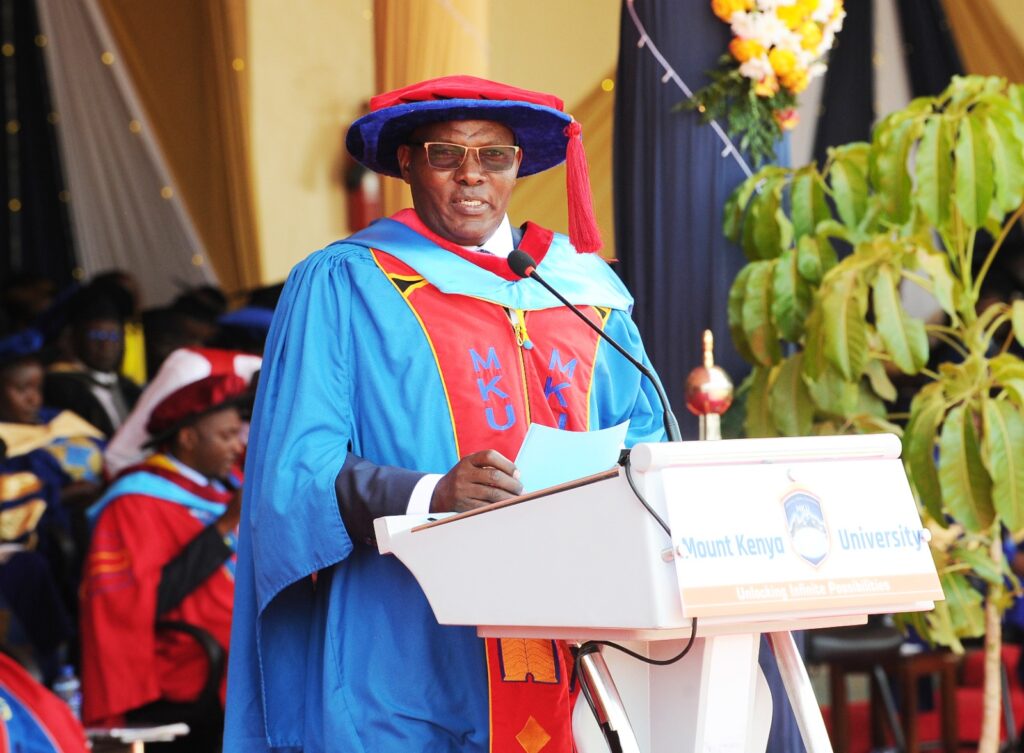
Photo/National Association of Private Universities in Kenya ( NAPUK) secretary general and Mount Kenya University (MKU) Pro-Chancellor, also Chairman of the MKU university Council, Dr Vincent Gaitho. PHOTO: File.
The emergence of robust data protection legal frameworks, including Kenya’s data protection regulations, demands that universities rethink how they collect, store, process, and share information. Compliance is no longer a matter of administrative routine; it is a pillar of institutional credibility and trust. Students, staff, and partners must have confidence that their personal data is handled with integrity, confidentiality, and transparency.
“Universities must therefore invest in strong data governance systems, digital security infrastructure, and continuous staff training to ensure responsible data stewardship. Beyond compliance, data should be leveraged strategically — not merely stored — to drive informed decision-making, improve student support services, and strengthen academic quality. Institutions that master data care will gain a competitive advantage, building reputations as safe, trustworthy, and forward-looking centers of learning,” he said.
Dr Gaitho said the future of higher education in Kenya will not be shaped by numbers alone, but by courage, collaboration and relevance. Universities stand at a defining moment one where tradition meets transformation and where survival depends on the ability to innovate, adapt and lead.
Institutions that place students at the center, prioritize impactful research, embrace data responsibility and prepare intentionally for emerging educational realities will shape the next chapter of national development.
Private and public universities alike must see themselves not as competitors in isolation, but as partners in building a knowledge-driven society. The challenges of the Global South demand institutions that produce solutions, not just graduates; ideas, not only credentials. By fostering collaboration, nurturing innovation ecosystems, and aligning learning with societal needs, universities can become engines of economic growth and social transformation.
As of late 2025 and early 2026, KAPU has been heavily involved in high-stakes negotiations and potential litigation against the Kenyan government regarding the funding of students placed in private universities through the Kenya Universities and Colleges Central Placement Service (KUCCPS).
KAPU has highlighted that the government owes private universities billions in unpaid fees for students placed in their institutions. Estimates for this debt have been cited as high as Sh58.8 billion as of late 2025, which has forced many private institutions to strain their financial reserves to continue operations.
Meanwhile, Rwanda’s High Commissioner to Kenya has praised MKU’s cross-border partnerships and called for stronger East African integration. The diplomat, Ernest Rwamucyo, has also commended MKU for the role it has played in cross-border education partnerships and shaping the next generation of East African professionals.
Speaking during a visit to MKU’s main campus in Thika town, Amb Rwamucyo described the institution as a “strong partner,” underscoring how higher education is increasingly becoming a pillar of Kenya–Rwanda relations.
“MKU is an important partner for Rwanda. The institution took faith in the country despite Kenya having a big market for education and a growing population, but still the university’s founders and its leadership thought it worth partnering with Rwanda,” he said when addressing students.
In addition to having a presence in Rwanda, students from Rwanda study at MKU campuses in Kenya to study and we will continue to come for some disciplines that are not available in Rwanda,” said the diplomat.
The High Commissioner advised Rwandese students pursuing their studies at the university to foster relations with fellow students who come from other countries in the region. He said the current crop of students would in future become the business leaders and policy makers in the years to come, and that cultivating relationships now would help them professionally in the years to come, but also play a part in deepening relations within EAC in future.
“At the university, you learn and get exposure. There are opportunities in the region. So you should have an open mind. The world is increasingly interconnected,” he said. “MKU is a big university, very big campus with students from so many parts. I’m sure there are students from Uganda, Somalia, South Sudan, the Democratic Republic of Congo and other parts of Africa.”
“So make friends. Interact with them, grow your network and connections. Build a lot of social capital with them. This is because the people that you connect with today are going to be your network. And they’re going to grow with you professionally in their career… You may end up in different institutions, but those are the bonds that are going to propel you to higher places,” said the envoy.

Photo/Musician Size “8” (left) and her team performing during the MKU’s Thanksgiving celebrations held on Sunday February 22 at the Mwai Kibaki Convention Centre. She was a guest artist at the church service. Photo: Courtesy.
MKU Vice Chancellor Prof. Deogratius Jaganyi said such interactions among the students would open up the worldviews of the learners, enabling them to become better professionals. “We want to see more of this kind of linkage. When students from diverse backgrounds interact, they get exposure…. we want to see the internalisation of MKU,” he said.
During the visit to MKU in Thika this week, Prof Simon Gicharu, the founder and chairman of MKU, presented him with a copy of “Mountain Meet land of 1,000 Hills”, a book that narrates the journey that Mount Kigali University, Rwanda (MKUR), which is affiliated to MKU, has taken.
The book looks at how Mount Kenya University overcame the challenges it encountered when it swam headlong into the uncharted waters of cross-border education as well as the social and economic impacts of this move.
Prof Gicharu and Amb Rwamucyo also held a meeting during which they discussed various issues regarding higher education in Kenya and Rwanda. The engagement highlighted the strong ties between Kenya and Rwanda and reaffirmed the shared commitment to advancing education, research and regional collaboration.