

By James Wakahiu
Mount Kenya University (MKU) has unveiled a strategic collaboration with senior school principals in Kenya aimed at curbing rising cases of student unrest and other challenges through professional mediation training programmes.
The initiative, presented during the 2026 Kenya Secondary School Heads Association (KESSHA) Annual National Conference going on in Mombasa, underscores a shift from reactive disciplinary measures to proactive conflict resolution within schools.
At the heart of the initiative is MKU’s Institute for International and Development Law (IID Law), which is championing a structured approach to dispute resolution by equipping principals with certified mediation skills designed to address conflicts before they escalate into strikes or acts of arson.
Held under the Theme: Strong Schools and Collaborative Leadership for Promoting Competency -Based Education, the teachers conference opened on Monday, June 22, 2026 at the Sheikh Zayed Hall, Mombasa.
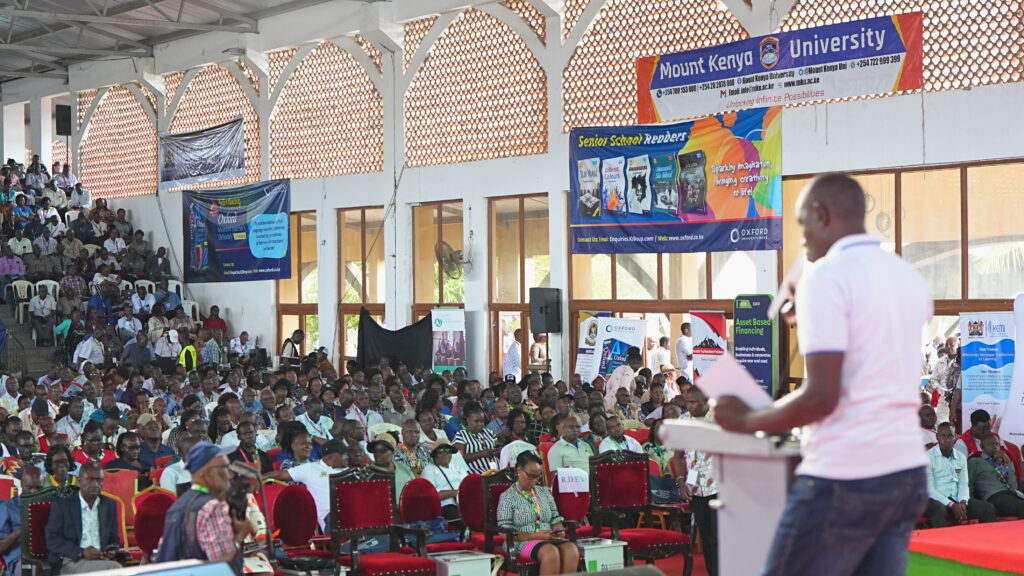
Photo/Guest speaker addresses delegates at the ongoing 2026 Kenya Secondary School Heads Association ( KESSHA) Annual National Conference at Sheikh Zayed Hall, Mombasa. Photo; Courtesy
The conference comes at a time when local secondary schools are grappling with an upsurge in student unrest, particularly during the second academic term. Traditionally, school managers have relied heavily on punitive discipline, but MKU is advocating for a paradigm shift.
Speaking at the forum, Principal IIDLAW, Judy Ngayu emphasized that professional mediation provides a safer and more constructive alternative. By training principals as mediators, schools can create internal mechanisms that prioritize dialogue, understanding, and early intervention, she said.
“Principals are often the first responders when crises occur in schools,” Ngayu noted. “Through mediation training, we empower them to address grievances at their root, fostering stability and preventing escalation,’’ she said.
The collaboration integrates academic expertise from IIDLaw with practical educational leadership experience from MKU’s School of Education. This multi-sectoral approach ensures that principals not only understand legal and ethical dimensions of mediation but also learn how to implement these skills effectively in safe school environments.
The Certified Professional Mediation (CPM) programme offered by IID Law provides formal training in negotiation, conflict analysis and dispute resolution frameworks. Participants who complete the course can go further to gain accreditation from the Judiciary’s Mediation Accreditation Committee (MAC), enabling them to handle both institutional and court-annexed disputes.
The programme remains dynamic and industry-responsive through strategic collaborations with nationally and internationally accredited partners, ensuring participants receive globally relevant, practical, and professionally recognized mediation training.
This accreditation elevates the role of school principals beyond administrators to recognized conflict resolution practitioners, giving them credibility and authority in managing disputes within and beyond the school setting.
According to MKU, one of the key benefits of the programme is the establishment of strong internal grievance systems. Schools that embrace mediation are expected to cultivate a culture of openness, where students feel heard and conflicts are resolved through structured dialogue rather than confrontation.

Photo/ Attentive Kenya Secondary School Heads Association ( KESSHA) members in their Annual National Conference at Sheikh Zayed Hall, Mombasa. Photo; Courtesy.
The conference brings together school leaders and education partners to share ideas and shape the future of teaching and learning. Attended by hundreds of delegates from the education sector, it will close on Friday, June 26, 2026.
Education experts at the conference highlighted that unresolved student grievances—ranging from academic pressure to welfare issues—often act as triggers for unrest. By equipping principals with mediation skills, schools can detect and address these concerns early.
“Dialogue creates trust,” said an education specialist from MKU’s School of Education. “When students know their voices matter, the likelihood of unrest reduces significantly,’’ he added.
Incentives to Encourage Participation
To encourage uptake of the programme, MKU announced a special incentive for KESSHA conference delegates. Principals enrolling in the CPM course through IID Law receive a Sh3, 000 discount on application fees when using a designated conference referral code.
The offer reflects MKU’s commitment to making professional development accessible while reinforcing its role as a partner in advancing educational leadership in Kenya.
The partnership between MKU and school principals signals a broader rethinking of discipline and governance in Kenyan schools. Rather than relying solely on rules and sanctions, the focus is shifting toward building relationships, enhancing communication, and promoting restorative practices.
Officials from MKU expressed optimism that the initiative will not only reduce incidents of unrest but also contribute to improved school climates, better academic outcomes, and stronger community ties.
KESSHA members welcomed the proposal, noting that principals are increasingly under pressure to manage complex student dynamics in a rapidly changing social environment. Many expressed interest in enrolling in the mediation programmes as part of their professional development.
As Kenyan schools strive to solve challenges related to student unrest, MKU’s collaboration with principals through its Institute for International and Development Law and School of Education offers a forward-looking solution. By investing in professional mediation, the initiative seeks to transform schools into spaces where dialogue prevails over conflict and stability replaces disruption.
If widely adopted, this approach could redefine how educational institutions across the country handle disputes—placing mediation at the center of school leadership and governance.