


The Mountain Journal
There are more farmers in Mt Kenya region working towards supply of the safe foods in the local markets, as well as playing a crucial role in protection of the environment along Aberdare Forest Catchment.
Demand for safe foods has increased forcing many farmers in Murang’a and Kiambu to accelerate the production of the safe foods through certification of being agro ecology practices.
The safe food farming is supported by Participatory Ecological Land Management Use (Pelum) through five collaborators, Organic Agriculture Centre of Kenya (OACK), Sustainable Agriculture Community Development (SACDEP).
Others are Community Sustainable Development Programme (COSDEP-Kenya), Resources Oriented Development Initiatives (RODI Kenya) and Institute for Culture and Ecology (ICE).
In the initiative there are more than 100,000 households in the two counties roped in the production of the safe foods eying to satisfy the rising demand.

Photo/ A sign post directing customers to a farm in Kangari in Kigumo where farming of safe foods is practised.
Interestingly, the farmers have reduced land under tea and coffee, replacing them with staple foods , vegetables, and fruit trees which are economical for the families, saving them from relying on the cash crops.
The Aberdare catchment is the source of water in the lower eastern and the coastal region, thus the farmers are educated to stop soil erosion and stop usage of the chemicals for the interest of other water users.
Initiated outreach programmes reaching the farmers, with the objective of promoting organic farming and environmental conservation.
According to a programme officer Pelum Mr Jeff Kahuho, five NGOs are implementing the Integrated Watershed Management for Diverse Farming Enterprises (IWAMA DIFE II) Project, which is successful with locals in the counties doing organic farming and selling their tea and coffee.
In the major markets in Thika, Kangari, Kirwara and Nairobi, among others, the county governments have allowed agro ecological farming practitioners establish shelves in the market area for easy identification by the customers.
In the advocacy for environmental conservation, farmers in Mataara area in Gatundu North turned to usage of energy saving jikos, to save trees through support of Rodi Kenya.

Photo/ An energy saving jiko in use.
Samuel Maina Ndirangu 60, says through Kangari Organic Farmers Market (Kofarm) a lot of benefits have been realized.
Ndirangu says the farmers have been trained in making the compost manure the best in organic farming.
“In the past 10 years, the tea farmers have been minting more money from the sale of the organic foods, earning more as compared to the sale of the green leaf to tea processing factories,” said Ndirangu.
Margaret Muthoni is among the 190 farmers in Gatundu North who use eco-friendly jikos, apart from planting fruit trees for the purpose of conservation.

New Beginning Group with 36 members, its leader Margaret Muthoni says destruction of trees stopped upon introduction of friendly jikos in the locality.
“The destruction of trees was high along the Aberdare Forest catchment and now the trend went down on introduction of the energy saving jikos.
The farmers have learnt on water harvesting techniques which has seen water bills reduced,” said Muthoni, a tea farmer.
Another resident, Ms Nancy Wangui Kahiga says the reduced tea farms concept has helped the farmers diversify to other crops.
She adds that there are productive kitchen gardens, which produce more rearing poultry for meat and eggs.
“ In this locality Rodi Kenya has supported the three community groups, chicken brooders and implementation of energy saving jikos,” said Ms Kahiga.

Moses Mbiri, an official at Rodi Kenya says tea farmers are leading in tree planting, as they cut the size of their tea farms for establishment of kitchen gardens.
In the past, he added, millions of shillings from the tea farmers were spent in buying food from other parts of the country, thus capital flight.
“Today the tea farmers produce vegetables for their families, and sell the surplus to the local market,” said Mbiri.
In Ndunyu Chege locality in Gatanga was prone to incidences of landslides, which has since reduced through farmers planting of trees in their tea farms, for the purpose of holding soils.
John Nyagia Njuguna said in 2006 and 2007 residents in Ndunyu Chege were victims of landslides following heavy rains leading to massive movement of soils.

After the catastrophes many of the residents relocated to safer grounds, and returned after a local NGO Sacdep helped in reclaiming the land previously destroyed by the landslide.
“We had been desperate following the incidents but we have been helped in water harvesting and establishing water pans to irrigate our kitchen gardens,” said Nyagia.
Sacdep official Ms Joleen Wambui says the food security programmes through crop diversification have helped the farmers in improved earnings and diet.

“ Gatanga located along Aberdare, there is a need to educate the locals to stop the use of chemicals in their farms and to plant environmentally friendly trees,” said Wambui.
Mr Jeff Kahuho, a programme coordinator at Pelum, says the number of farmers engaging in agro ecological practices has been on the rise, a testimony of a bright future in the production of safe foods.
The ecosystem, he says, is crucial for the lower Eastern as it helps in production of water thus encouraging farmers to stop use of chemicals and conserve the environment" said Kahuho.
Murang’a Agriculture CEC Prof Kamau Kiringai said more farmers are being trained on agro ecological practices.

Photo/ John Nyagia Njuguna watering his cabbages with water sourced from a water pan.
Murang’a, he said, is the first country to embrace agroecology farming.
“There is a need to engage the farmers and recently a delegation from Vihiga county toured our safe food farms," said Kiringai.
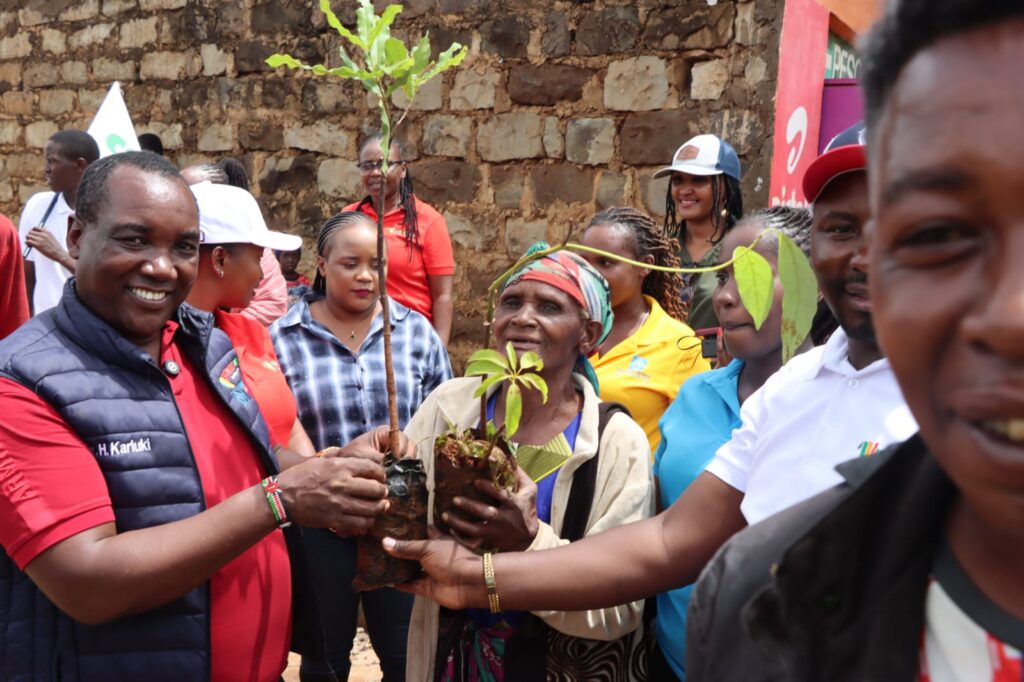
This year for the purpose of protection of the environment, Rodi Kenya has 3,500 tree seedlings for distribution to farmers in Murang’a, Kiambu, Kajiado and the environs.
www.themountainjournal.co.ke


Reader comments 0
Join the conversationLeave a comment
Your email address will not be published. Comments are subject to moderation.